



>90%
of global climate finance goes towards climate mitigation (Climate Policy Initiative, 2025)
Adaptation & Resilience
The impacts of climate change are already harming people and imposing costs on economies, with emerging markets and developing economies bearing the greatest burden. Floods, droughts, storms, and extreme heat upend lives, damage assets, disrupt supply chains, and strain public budgets.
In low- and lower-middle-income countries, GDP per capita is already an estimated 4% to 12% lower because of rising temperatures and sea levels (Grantham Research Institute, LSE, 2026). Climate adaptation is the process of adjusting to actual or expected climate impacts to limit harm. Resilience is the capacity that process builds: the ability to absorb shocks, recover, and keep functioning.
Strengthening the capacity of regions, countries, and companies to adapt and build resilience is therefore essential for protecting and strengthening macro-economic health. Examples of adaptation investments include climate-resilient infrastructure, flood and coastal protection, drought-resistant agriculture and improved irrigation, water storage and management systems, resilient power grids, and cooling solutions that protect people and assets from extreme heat.
The adaptation finance gap is large and growing. Current flows would need to increase by 12-14 times to meet developing countries’ needs (UNEP Adaptation Gap Report, 2025). While adaptation finance has grown in the past decade, more than 90% of global climate finance still goes towards mitigation (Climate Policy Initiative, 2025), which reduces emissions that drive climate change, rather than adaptation, which helps communities and economies manage impacts already being felt.
Adaptation and resilience investments are often harder to finance than energy investments, because their returns can be more challenging to quantify and attribute, while many of their benefits of these investments take longer to materialize. Financing adaptation and resilience demands decision-makers to invest now to avoid damage later, which requires forward-looking data on hazards, exposed assets and existing protections. Benefits rarely come through a single, predictable revenue stream, making the investment case more complex to build than most mitigation projects.
But adaptation can deliver strong economic returns, and financial institutions are already financing them. Resilience measures return a median of around four times their cost (Grantham Research Institute, LSE, 2026). In a 2026 GFANZ collection of 22 adaptation case studies, nearly half involved only private institutions using standard loans, bonds, equity and insurance. Where benefits are too dispersed or risks too high, concessional capital can help close the gap. Indeed, blended finance for adaptation rose 133% to USD 5.6 billion in 2025 (Convergence, 2026). Moreover, finance ministries and central banks are bringing physical climate risk into fiscal and macroeconomic planning, which can help bring more public and concessional capital to adaptation deals.
This section contains resources to help finance professionals, policymakers, educators and others build the understanding and skills to identify, assess and finance adaptation, from physical risk assessment and shared taxonomies and metrics to financing models that mobilise private capital for adaptation.
Featured Resources
View all resourcesView all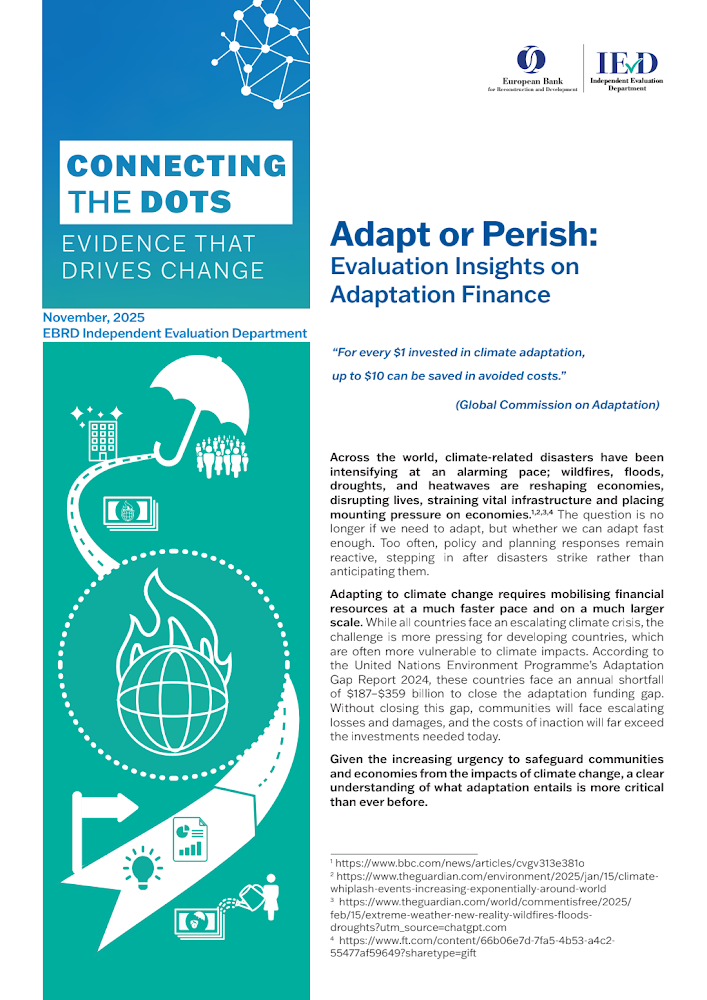
Adapt or Perish: Evaluation Insights on Adaptation Finance
This resource synthesizes evidence from 55 independent evaluations and industry reports to explore how MDBs, governments, and their partners can design adaptation projects, deploy adaptation finance, and translate financing into climate resilience.
European Bank for Reconstruction and Development (EBRD)
Investing in resilience: Lessons from private finance for unlocking investment in adaptation
This resource presents 22 in-depth case studies exploring how financial institutions are supporting adaptation and resilience through practical financing solutions, alongside lessons on how approaches can be replicated and scaled.
Glasgow Financial Alliance for Net Zero (GFANZ)
Climate Resilience Investment Framework (CRIF)
The Climate Resilience Investment Framework supports investors seeking to develop individual climate resilience goals and implementation strategies, with a focus on managing physical climate risks from a financial materiality perspective.
Institutional Investors Group on Climate Change (IIGCC)
Physical Risk & Climate Change Adaptation and Resilience: A Curated Guide for Financial Institutions
This guide provides a curated overview of key A&R finance resources from public and private entities, summarizing core elements and organizing them by A&R themes to help financial institutions identify and access the most relevant materials.
Glasgow Financial Alliance for Net Zero (GFANZ)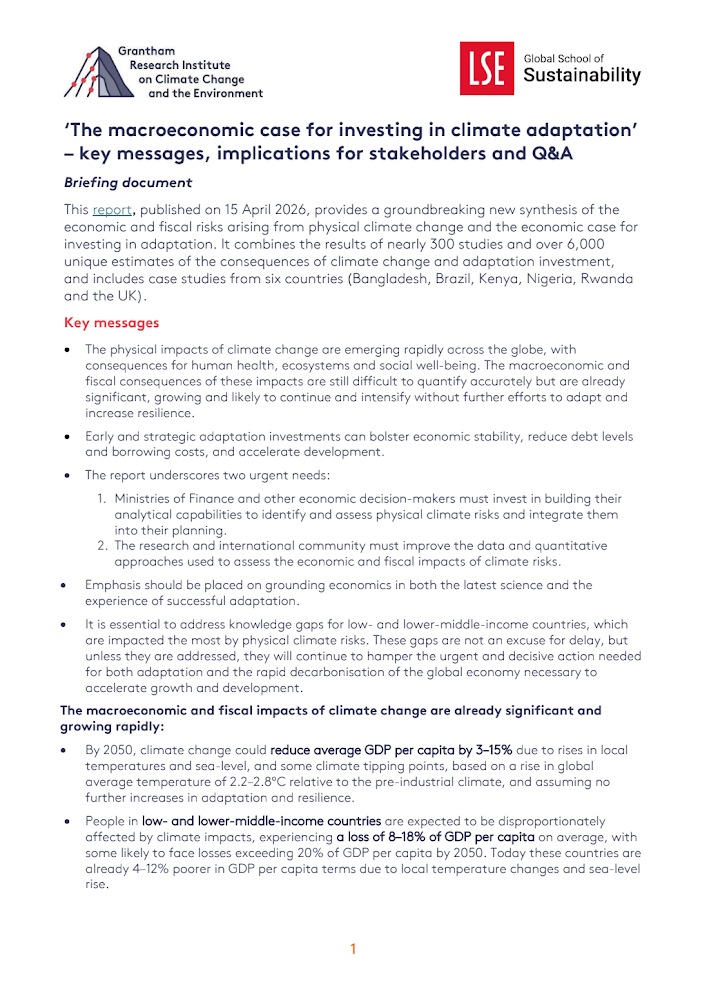
‘The macroeconomic case for investing in climate adaptation’ – key messages, implications for stakeholders and Q&A
This resource provides a synthesis of the macroeconomic and fiscal risks of climate change and the economic case for investing in adaptation, drawing on nearly 300 studies and over 6,000 estimates, with case studies across six countries.
Grantham Research Institute, London School of Economics (LSE)
Toolkit for engaging the private sector in National Adaptation Plans (NAPs)
This resource is a practical toolkit designed to help public sector and non-state actors engage the private sector in climate and NDC implementation. It provides a structured approach to designing effective engagement strategies.
United Nations Framework Convention on Climate Change (UNFCCC)NAP Global Network
Efforts of developing countries in assessing and meeting the costs of adaptation: Lessons learned and good practices
This resource examines how developing countries assess and address the costs of climate adaptation, drawing on national plans, communications, and case studies
United Nations Framework Convention on Climate Change (UNFCCC)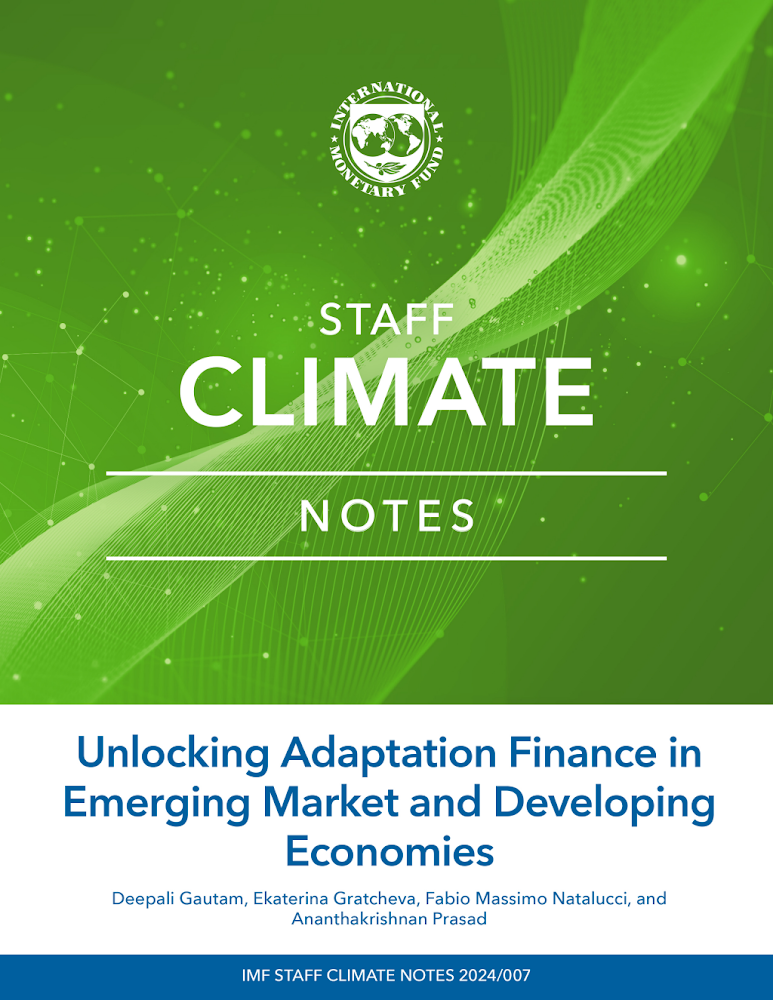
Unlocking Adaptation Finance in Emerging Market and Developing Economies – IMF eLibrary
This report discusses how to mobilize private finance for climate change adaptation in developing countries, where adaptation efforts have largely relied on public funding. It outlines strategies to overcome investment barriers and create enabling environments for private sector engagement, while embedding adaptation into national and sectoral planning processes.
International Monetary Fund (IMF)
Case Studies
View all resourcesView all
Improving climate resilience and land restoration in Brazil through ‘Renova Pasto’
Renova Pasto, a long-term blended finance credit line launched in 2022 supports the rehabilitation of degraded pastureland and accelerates compliance with Brazil’s Forest Code, which mandates the preservation of native vegetation and restoration of legally protected areas. The program combines long-term loans provided by Rabobank with partial credit guarantees from the AGRI3 Fund and technical assistance delivered by IDH and local implementation partners., The concept for Renova Pasto originated with a 2020 transaction in which AGRI3 provided a partial guarantee that enabled Rabobank to extend a 10-year loan to a cattle producer for pasture restoration, productivity improvement, and Forest Code compliance. The partial guarantee enabled Rabobank to extend longer-tenor financing, beyond its standard risk appetite for such investments. Rabobank’s standard risk/return expectations due to the longer tenor and inclusion of non-revenue generating activities, such as forest conservation and restoration., Recognizing that bespoke blended transactions are slow and operationally intensive, Rabobank and AGRI3 subsequently developed Renova Pasto as a standardized and replicable credit product. The program incorporates pre-negotiated eligibility criteria, defined environmental safeguards, and structured monitoring requirements that are fully embedded within Rabobank’s credit approval process., Under the program, Rabobank provides eligible farmers with loans of 10 years’ tenor, with a 3-year grace period during which no repayments are due (though interest is charged on the outstanding amount). These loans are supported by partial guarantees from AGRI3, covering the final 3 years of the transaction. This enables Rabobank to extend financing beyond its typical tenor. The longer tenor allows for less stringent repayment requirements for the farmer, supporting investment in non-revenue-generating activities., Environmental requirements are directly integrated into loan contracts, with farmers receiving a standardized Environmental and Social Action Plan. Clients must comply with a range of environmental safeguards, contractually committing borrowers to no deforestation (i.e. no conversion of native vegetation) in the financed area, monitored using CAR registry data, satellite imagery and on-farm verification processes where the renovation project is implemented and a target of conservation of native vegetation across their entire land portfolio. Non-compliance is subject to contractual remediation measures and monitoring under the loan agreement., Recommended farming methodologies are aligned with technical recommendations issued by Embrapa (Brazilian Agricultural Research Corporation), a state-owned enterprise under Brazil’s Ministry of Agriculture and Livestock. Technical assistance by IDH and local partners provides on-the-ground advisory support to ensure good agricultural practices, strengthen compliance, and monitor environmental and productivity outcomes., Pages 91-94
Glasgow Financial Alliance for Net Zero (GFANZ)
A regional platform for mobilizing private reinsurance in sovereign disaster risk financing
This case study examines the Southeast Asia Disaster Risk Insurance Facility (SEADRIF ) which is a regional disaster risk financing platform that provides ASEAN countries with pre-arranged, rules-based financing to strengthen resilience against climate shocks. As disaster frequency and severity increase, governments face growing fiscal pressure, with post-disaster financing often delayed and insufficient. SEADRIF addresses this by shifting disaster financing from reactive to proactive, enabling governments to access rapid and predictable liquidity when shocks occur. SEADRIF blends public capital and private reinsurance to translate disaster risk into parametric insurance products that protects vulnerable communities and countries from the economic and fiscal impacts of natural disasters. Governments pay premiums, and payouts are triggered based on predefined conditions, allowing funds to be disbursed within days rather than months. Since 2021, SEADRIF successfully mobilized US$29.5 million in private risk capital through insurance contracts with multiple reinsurers, and has paid out US$6.5 million, all within days of the triggers being reached., Refer to pages 96 to 100 for details.
Glasgow Financial Alliance for Net Zero (GFANZ)
Sovereign resilience through catastrophe bonds
This case study examines the renewal of the World Bank catastrophe bond by Jamaica. In 2024, the Government of Jamaica decided to renew a World Bank catastrophe bond which expired in 2023 with a new issuance. By extending the coverage for another four hurricane seasons, they sought to maintain the resilience of Jamaica’s public finances in the event of extreme hurricane events., The World Bank issued a US$150 million catastrophe bond and simultaneously entered into a risk transfer agreement with the Government of Jamaica. Jamaica pays a premium for the coverage reflecting the terms the World Bank achieved on the bond., Aon Securities acted as the joint lead manager of the bond issuance, helping to design the instrument and then place it with the capital markets., Unlike traditional insurance, the bond uses a parametric “Cat-in-a-grid” trigger. Payouts are determined by storm characteristics, specifically central pressure and path, as they cross defined geographical boxes across and around the island. As such, the payout is not related to the actual losses that the country experiences and so can be independently verified and completed quickly providing the government with an injection of funds at the time where recovery and reconstruction costs spike., On October 28, 2025, the Category 5 Hurricane Melissa hit Jamaica, meeting the parametric conditions and triggering a full US$150 million payout. Jamaica received these funds on December 1, 2025, allowing for rapid post-disaster recovery., Refer to pages 23-26 for details.
Glasgow Financial Alliance for Net Zero (GFANZ)
Financing reef resilience to extreme climate events with parametric insurance
Rapid disaster responses are essential for conserving the benefits that healthy reefs provide, however they are rarely included in post-disaster management plans and budgets. Instead, reef response is often dependent on reactive, time-consuming, and often unreliable fundraising, which disincentivises future investment. The Mesoamerican Reef (MAR) Fund, supported by WTW developed a uniquely designed parametric insurance product to provide cost-effective coverage to priority sites along the Mesoamerican Reef. This first insurance policy was purchased by the MAR Fund with financial support from the InsuResilience Solutions Fund. This is a use of parametric insurance, which is a type of insurance that pays the policyholder a set amount following an event rather than an amount based on calculated losses. This enables rapid, post-storm payouts. Storm wind intensity triggers immediate, post-storm payouts at specific levels to cover the costs of reef recovery response.
United Nations Environment Programme Finance Initiative (UNEP-FI)
Education & Training

M.S. in Climate Finance
The Master of Science (MS) in Climate Finance is a 39-credit professional degree offered by the Columbia Climate School in collaboration with Columbia Business School. The interdisciplinary course integrates climate science with financial management to equip students with decision-making skills to respond to climate change.
Columbia Climate School, Columbia University
The Common Principles: e-learning videos - Strengthening Green Finance Tracking for Finance Mapping
This series of short e-learning videos supports IDFC members and public development banks in accurately tracking and reporting green finance using the IDFC/MDB Common Principles, which underpin the Green Finance Mapping (GFM) initiative.
Climate Policy Initiative (CPI)International Development Finance Club (IDFC)